AI-Enhanced Google Shopping Campaigns
Google Shopping Campaigns That Drive Predictable Revenue
Search advertising changed fast. Google rolled out automation, Performance Max, and Merchant Center Next, and the playbook most brands relied on no longer holds up. You cannot just flip ads on and expect stable performance. You need clean data, strong feed management, and Google shopping campaigns that react to real signals in real time.
Most brands run into the same problems because the setup behind their campaigns is outdated.
Search ads chase clicks instead of sales.
Shopping feeds carry errors or missing details.
Performance Max runs on autopilot with no guardrails.
Budgets drain on searches that never convert.
Teams cannot tell what actually moves revenue.
Interact Marketing focuses on fixing those gaps. We pair AI-supported optimization with actual platform expertise, so every ad serves a purpose and every decision ties back to real business outcomes.
Why Most Search and Shopping Campaigns Underperform
1. Automation Without Strategy
Google leans heavily on automation now. That is fine until you let the system run without direction. Many campaigns end up too broad and too expensive because no one is steering. The ads run, but the results stay flat.
Our approach is different.
We guide automation with AI insights that help shape the intent.
We build search structures that filter out noise instead of chasing it.
Performance Max gets human oversight, so it pushes toward profitable signals instead of random traffic.
2. Weak Product Feeds Break Shopping Performance Early
Your feed controls almost everything in Shopping. If the data is sloppy, incomplete, or mislabeled, performance drops before the campaign even launches. You can have great products and still lose the auction because the feed is unclear.
We handle that by auditing Merchant Center next, cleaning attributes, and enriching product data with AI tools. When the feed is clean, impressions rise and clicks cost less. That alone can shift an entire account.
3. No Clarity on What Actually Drives Revenue
Some reports tdiscussimpressions and clicks, but that does not tell you what contributes to sales or margin. Without that link, you end up guessing. And guessing means wasted spend.
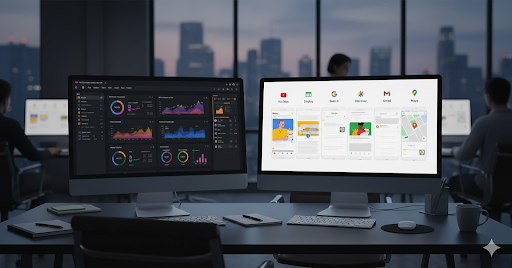
We build dashboards that tie ad spend to revenue and ROAS. We model seasonal changes so you know what is coming. You see what works and what should be replaced.
Our Search and Shopping Services: Smarter, Faster, More Profitable
Search Campaigns with Responsive Search Ads
We refine keyword intent using AI-supported research, ad variation modeling, and steady testing. The ads stay relevant and focused on conversions instead of empty traffic.
Performance Max Campaign Optimization
Performance Max can produce strong results, but only when someone shapes the signals behind it. We build audiences, creative sets, feed structures, and data layers that help Google target higher quality paths. The automation becomes useful instead of unpredictable.
Standard Shopping Campaigns
When a brand needs tighter control, we use Standard Shopping. We structure campaigns by margin, performance history, and search intent groups. That gives you clearer bidding decisions and cleaner reporting.
Merchant Center Next Product Feed Management
We take care of the details that decide whether your products show at the right moment.
Feed setup and clean up.
Attribute mapping and improvement.
Fixing errors before they spread.
Automated enrichment using AI-generated metadata.
A healthy feed means better visibility and smoother conversions.
Local Inventory Ads
For local merchants, we help connect online searches with in-store buying. When the inventory feed is accurate, nearby customers see what is available right now. Local searches often convert quickly. Our job is to make sure you appear when that moment happens.
Why Choose Interact Marketing for Google Shopping Campaigns
- Deep experience with large Google Ads accounts.
- AI-supported optimization without giving up control.
- A connected system across search, shopping, feeds, and analytics.
- Human specialists who understand the business goals behind the metrics.
- Strategies designed to get the most out of ROAS, not just impressions.
The result is a campaign system that adjusts with the market and keeps improving as data grows.
Most accounts have the same issue. Money goes into Google Ads, but no one can clearly say which searches, products, or audiences are actually driving profit. We use AI to clean the feed, tighten search intent, and align reporting with real revenue so you can finally see what to keep, what to cut, and where to scale. It works for both, just in different ways. Ecommerce leans on product feeds, Shopping, and Performance Max. Service businesses rely more on search intent, lead quality, and call or form tracking. The shared goal is the same: use better data and structure so you are not paying for empty clicks. We usually fix rather than rebuild. That means reviewing your structure, feeds, audiences, and tracking, then making changes where problems show up. If the account is beyond repair, we may build a cleaner framework beside it, but the goal is always to protect what works while removing what doesn’t. You don’t need enterprise-level spend, but you do need enough traffic for the system to learn. If your ads only get a few clicks per day, it’s impossible to optimize. Once you’re generating consistent weekly conversions, smarter structure and AI support start delivering returns. More control. Google’s automation is already running in the background. What we do is give it cleaner inputs and better guardrails. You see which search terms, products, and audiences are pulling their weight, and you get reporting that connects those insights directly to revenue or ROAS. Feed cleanup and cutting obvious waste often show up in the first few weeks. Bigger performance gains come as the account moves through learning phases and collects more conversion data. You should feel clarity early, and see stronger numbers as the structure settles in. FAQs: AI Enhanced Campaigns
Managing a Google My Business (GMB) profile isn’t a task you finish once and forget—it’s [...] 
Integrating AI Tools for Effective Google My Business Management
May